
A new family of engines, designed fast
A digital-first approach drives Pratt & Whitney’s push into propulsion for smaller, newer platforms
A suite of digital technologies is helping Pratt & Whitney deliver a new family of lightweight aircraft engines far faster than traditional techniques would ever allow – and meet an urgent need to power small munitions and uncrewed aircraft.
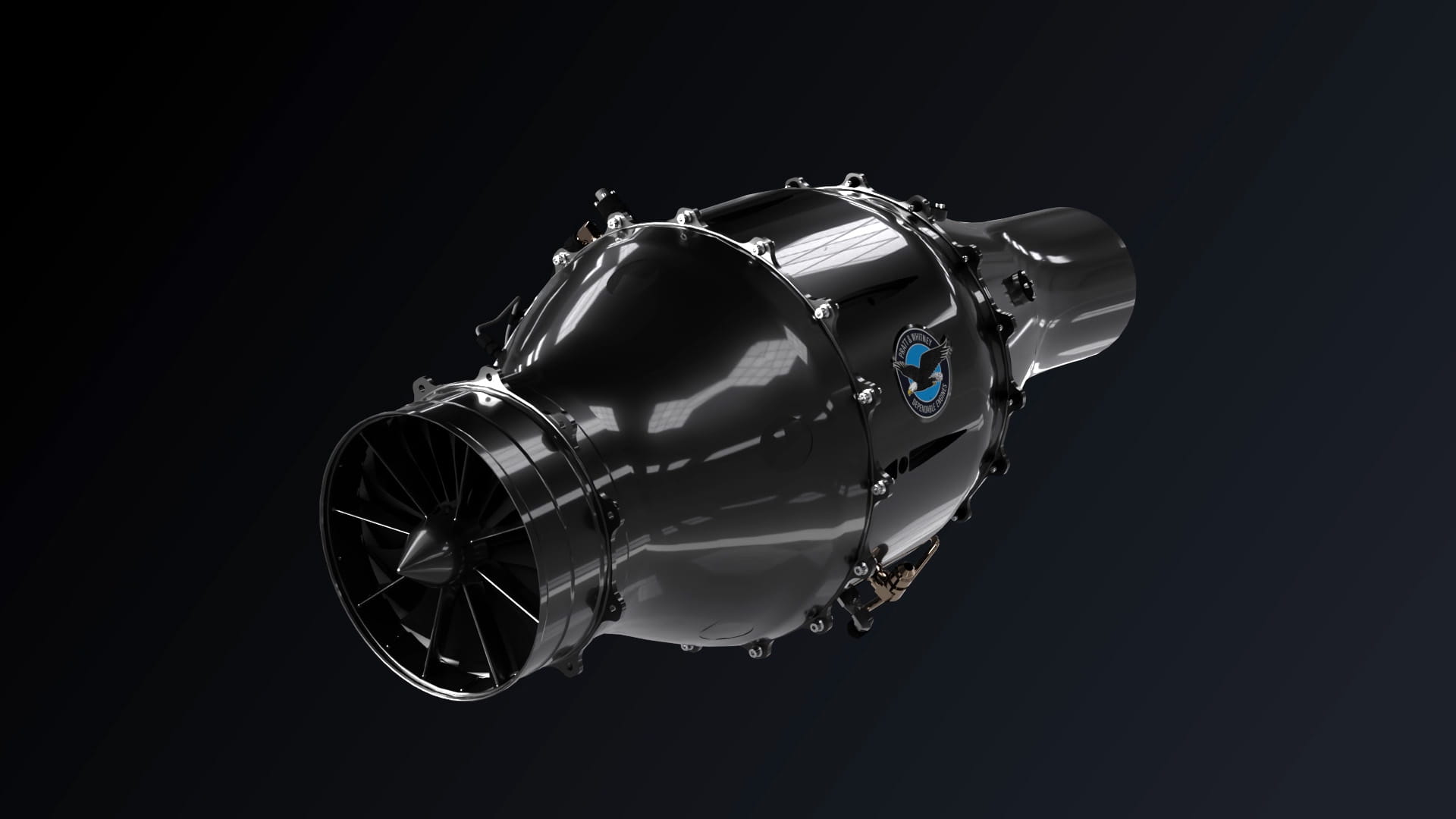
The engines are part of what’s known as the Valox™ family, whose variants could one day power multiple types of platforms. In the near term, they mark Pratt & Whitney’s push into propulsion systems designed for platforms with short lifetimes, a contrast to fighter jet engines that are developed over many years and built to remain in service for decades.
“Our customer’s focus is no longer only on what we can deliver in 10 years, but also on what we can field tomorrow,” said Chrissy Williams, who leads the Advanced Military Engines portfolio for Pratt & Whitney, an RTX business.
Engines built for affordable mass
The engines would power effectors and emerging applications such as autonomous collaborative platforms – aircraft that fly in large numbers alongside manned fighters to extend their sensing and communications capabilities, overwhelm adversaries and reduce risk to pilots.
“This is the 21st-century change in how we win and achieve victory on the battlefield,” Williams said. “It’s all about affordable mass right now and how you overwhelm your adversary.”
The nature of their mission means they can fly effectively with simplified engines – a factor that lends itself to production at scale.
Swift and sharp
The engine family name draws from two roots: the Latin velox, meaning swift, and the Greek-derived ox, meaning sharp, reflecting the mission’s need for speed, precision and power. Williams said the engines will fill a long standing gap in the small engine segment, where few propulsion options exist in their thrust class.
The new engines will:
- Deliver 500 to 1,800 pounds of thrust
- Power airframes from small munitions to large uncrewed aircraft
- Adapt to many different airframes
- Advance to production, within months, from a clean-sheet design
From models to metal
Inside an enclosed machine at Pratt & Whitney’s additive manufacturing lab in East Hartford, Connecticut, a laser sweeps over a bed of metallic powder. It flickers in fast, precise bursts, tracing a digitally drawn pattern that fuses tiny grains into a layer of metal as thin as a strand of hair.
When the pass is complete, the machine applies a new layer of powder, and the sequence repeats, eventually forming a metal part ready to take its place in an aircraft engine.
This process is called laser powder bed fusion, and it unlocks extraordinary speed. Parts that might take more than a year to make with traditional manufacturing methods can now be made in less than a week. The approach scales, too. Digital build files, once validated, can be shared across suppliers to make multiple units at once – a significant advantage when delivering affordable mass.
Additive manufacturing also opens up options. For example, design teams can consider new materials and architectures with intricate features printed directly into their components.
“You’re enabling your designers to think more aspirationally,” said Lawrence Binek, a Pratt & Whitney technical fellow for additive manufacturing. “What's really cool is, you start seeing design engineers thinking radically different, embracing what additive manufacturing is capable of.”
Across the Valox family, engineers are combining traditionally manufactured parts with additively printed components for the hot and cold section, using the new parts’ novel shapes and integrated features to unlock performance gains and new configurations.
The change is showing up in other Pratt & Whitney designs as well. The business recently completed demonstration testing of a TJ150 engine that, by volume, consisted of nearly 60% additively manufactured parts. That engine, about the size of a standard computer keyboard, is meant to fly missions that may last only 15 minutes or less. Current versions power Raytheon’s MALD® decoy and other smaller systems, but the new additively printed configuration could open up new applications.
Designing a digital-first engine
To design the parts printed in the additive manufacturing lab, engineers looked within Pratt & Whitney’s digital ecosystem, using a comprehensive thread of data to inform their decisions.
In the past, tracing a requirement through paper files could take months. Now, when a customer updates a requirement, the new version flows through the digital thread in seconds, showing how it affects performance, testing, cost and qualification.
“We’re able to ingest those changes and rapidly iterate on them to understand how that’s going to impact our product,” said Jonathan Sandoval, Pratt & Whitney associate director of systems engineering.Simulations will help refine designs and validate performance long before hardware or even a physical prototype exists. The result: When physical testing begins, the team already has a strong, data-supported hypothesis on what will happen.
The digital thread exists in Pratt & Whitney’s collaborative digital environment, a secure workspace with frequent updates. It lets Pratt & Whitney, the customer and suppliers collaborate using authoritative data.
“We are all working with the same data at the same time,” Williams said. “That allows us to move processes from being in series to in parallel.”
The RTX advantage
The team’s approach both breaks tradition and honors it. Specifically, it draws upon a century’s worth of Pratt & Whitney engines and the enormous database they’ve created.
“We have a hundred years of data that ensures our models are correct,” Williams said. “We can now use those models to fly forward into new development cycles.”
Across RTX, the new engines benefit from even broader expertise. The Valox family of engines is Pratt & Whitney’s eighth digital program, and the company was able to mature its digital engineering processes more quickly by drawing on Raytheon’s experience with model-based systems engineering. The collaboration also paves the way for new opportunities to integrate novel Pratt & Whitney propulsion into Raytheon effectors.For military operators, the payoff is propulsion that’s adaptable, affordable and ready when needed. And for the people building it, that urgency carries meaning. Williams, who comes from a military family, said the team draws motivation from knowing their work can keep service members farther from danger.
“We do this every day knowing our product, with all its intelligence and combat effectiveness, enables our loved ones to stay farther from the fight,” she said. “We can make sure we’re doing our part to bring them home.”