
Please review the frequently asked questions below for answers to some of the common questions and issues.
If you need additional support after reviewing this document, please send an email to the Sales Tax Department at [email protected] and provide the information requested in the answer to the first question below.
General sales and use tax questions
Questions regarding sales to a customer
- Legal entity/company code making the sale (e.g. Collins Aerospace is not a legal entity, it’s a d/b/a, Rockwell Collins, Inc. is a legal entity)
- Copy of the invoice and/or sales order #
- Description of what is being sold
- Where the item is being shipped to/or where the service is taking place
- Ship to location and ship from location determine taxability based on state
- Copy of customer’s exemption certificate/transmittal sheet if available
- Clearly describe what your issue/question is
Questions regarding a purchase from a vendor
- Legal entity/company code making the purchase (E.g. Collins Aerospace is not a legal entity, it’s a d/b/a, Rockwell Collins, Inc. is a legal entity)
- SAP PO # or Ariba requisition#, or equivalent information from non-SAP ERPs
- Describe in detail what is being purchased, how the item is being used and where the item is being shipped to/or where the service is taking place
- Please describe in detail the way it is used. For example, indicate if it’s something being incorporated into the item we are manufacturing to be sold, or whether it is M&E or tooling being used to manufacture goods or if used in R&D, quality control, material handling, MRO activities or some other operation or general facility usage
- If you are purchasing a service, please describe in detail what the service is and what operations/equipment the service is related to
- Clearly describe your issue/question
No. This email box does not respond to any other tax type questions other than US domestic S&U tax questions. Contacts for other tax areas are as follows:\
- Puerto Rico questions related to Hamilton Sundstrand de Puerto Rico – Sergio Montalvo and Himilce Hernandez
- Collins Aerospace master data issues – Kari Corson and Angie Beer
- Form W9 requests
- Collins Aerospace – [email protected]
- Pratt & Whitney – [email protected]
- Heritage Raytheon – [email protected]
- Form 1099 questions – Contact someone at the local business unit
- Income tax issues – Amy Bethel, Jack Byrnes
- Foreign VAT tax contacts
- Collins Aerospace – [email protected]
- Pratt & Whitney – [email protected]
- Raytheon – [email protected]
Create a SNOW ticket following the instructions in the document "KBA - Self service for Finance Tax Tech," found in the appendix.
Sales tax is imposed by a state or local government on the purchase of taxable goods or services at the time of sale and is collected by the Supplier from the Buyer. In contrast, a use tax applies when the Buyer purchases a taxable item from an out-of-state or online Supplier that does not charge sales tax or if the Buyer provides a direct pay permit to Supplier. In those cases, the Buyer – not the Supplier – is responsible for reporting and paying the use tax to their state.
A direct pay permit and an exemption certificate both affect how sales and use taxes are handled, but they work in different ways.
- Direct pay permit – Allows either a Buyer or Seller to purchase taxable items without paying sales tax to its Suppliers. A direct pay permit holder is responsible for calculating and remitting the appropriate tax directly to the state.
- Exemption certificate – a document either a Buyer or Seller provides to claim that a purchase or sale is exempt from sales tax & use tax under specific legal grounds – such as resale, manufacturing, or nonprofit status. In this case, the issuer of the certificate does not pay tax because the law exempts the transaction by statute or regulation.
Sales transaction questions
An exemption is a statutorily recognized reason that a sale is not subject to tax. When a Buyer qualifies for an exemption—such as purchasing goods for resale or using items in manufacturing, the Seller is absolved from charging sales tax to the Buyer on the transaction. To claim the exemption, the Buyer typically provides the Seller with a valid exemption certificate that documents why the purchase qualifies for an exemption.
Typically, all sales by RTX are considered taxable unless the customer provides a valid exemption or resale certificate. There are some situations where we will not require an exemption certificate to be kept on file. Examples can include
- The customer is a related party (wholly-owned RTX related entity, but a separate and distinct company)
- Direct sales to the US government (govt contractors are not automatically exempt)
Yes, a customer needs to provide a separate exemption certificate issued to each RTX legal entity that is making the sale. Buyer name on the exemption certificate must match the sold-to name in SAP.
Customers can use either the “Uniform Sales & Use Tax Resale Certificate-Multijurisdiction” or the “Streamline Sales Tax Certificate of Exemption” forms when submitting exemptions for more than one state. See appendix for examples of these certificates. However, not all states accept these multi-jurisdiction certificates. If a customer needs to provide an exemption for a state that is not listed on either of these two forms, then they will need to provide a certificate for each individual state.
- Resale – Used when our customer is purchasing goods (not including services) that they will resell to their customers. All states allow for a resale exemption.
- Common Carrier (if our customer is an airline providing transport for hire e.g. American, Delta and United Airlines, other major air carriers, regional airlines and cargo transporters for hire, FedEx, UPS, DHL, etc.) Used by common carriers making purchases of goods/services that will be incorporated into their aircraft. Many states (not all) exempt sales to common carriers. We will typically default an exemption for these customers, but you may receive actual exemption certs from them.
- Private/General Aircraft Exemption - Used by owners of aircraft when making purchases of goods/services that will be incorporated into their aircraft. Only a handful of states allow for an exemption by a private aircraft owner.
- Direct Pay (customer does not pay sales tax to RTX BUs - the State has authorized customers to make their own tax determinations and if taxable, they will assess and remit the tax directly to the State).
Exemption certificates are applied in SAP to the sold-to customer number and the ship-to state. The Buyer’s name on the exemption certificate must match the sold-to name in our SAP system. The Buyer’s name must match its legal entity name.
- Collins hUTAS – Exemptions are validated and stored in a third-party application called CertCapture. Customer Service must fill out a transmittal sheet, combine transmittal and exemption cert into one pdf document and then send email to CertCapture by using the email address on the transmittal sheet for the appropriate BU. See appendix for “Collins hUTAS Cert Upload Process” for specific instructions about submitting an exemption cert.
- Collins hRC - Exemptions are requested and collected by Customer Account Specialists. Certificates are sent to and validated by Customer Master with input from Tax Dept as needed. Certificates are stored in Vertex. Customer Master’s e-mail is [email protected].
- Pratt & Whitney – Not applicable since we don’t typically charge our customer’s sales tax.
- P&W Canada BUs - Exemptions are validated and stored in a third-party application called CertCapture. Customer Service must fill out a transmittal sheet, combine transmittal and exemption cert into one pdf document and then send email to CertCapture by using the email address on the transmittal sheet for the appropriate BU. See appendix for “PWC Cert Upload Process” for specific instructions about submitting an exemption cert.
- Raytheon Company - Exemptions are applied based on how a contract is set up in SAP. Key drivers are distribution channel (customer type), ship to address, price list type, usage, and material group.
- Collins hUTAS & PW Canada BUs – After an email is provided to CertCapture with your transmittal sheet and exemption certificate, you will receive an email back indicating whether the exemption cert was validated or rejected. If you do not receive a response, you should look in CertCapture. See standard work document called “Certificate Review in CertCapture Process V2” in Appendix for steps to review in CertCapture. If you still have questions, send an email to the Sales Tax Department at [email protected] with the following information:
- Legal entity/company code making the purchase (E.g. Collins Aerospace is not a legal entity, it’s a d/b/a, Rockwell Collins, Inc. is a legal entity).
- SAP PO # or Ariba requisition#, or equivalent information from non-SAP ERPs.
- Describe in detail what is being purchased, how the item is being used and where the item is being shipped to/or where the service is taking place.
- Please describe in detail the way it is used. For example, indicate if it’s something being incorporated into the item we are manufacturing to be sold, or whether it is M&E or tooling being used to manufacture goods or if used in R&D, quality control, material handling, MRO activities or some other operation or general facility usage.
- If you are purchasing a service, please describe in detail what the service is and what operations/equipment the service is related to.
- Clearly describe your issue/question.
- Collins hRC - When Customer Master receives the certificate and enters it into Vertex, they will respond via e-mail that the certificate has been applied to the customer’s account. Any issues with validation will be reviewed by the Tax Dept.
- RayCo - Not currently utilizing CertCapture. All RayCo BUs are responsible for collecting and verifying exemption certificates from all non-Government customers including Government contractors. Exemption certificates are not applicable for sales directly to the US Government.
- Collins hUTAS – You should review the exemption in CertCapture to make sure it was validated and that the effective date of the certificate is within the invoice or pricing dates. See standard work document called “Certificate Review in CertCapture Process V2” in Appendix for steps to review in CertCapture. If exemption cert appears correct, send question to Sales Tax Dept. at [email protected].
- Collins hRC – Review the exemption in Vertex to make sure the effective date is on or before the invoice and pricing dates. If exemption cert appears correct, send question to Sales Tax Dept. at [email protected].
- PW America BUs – N/A
- PW Canada BUs - You should review the exemption in CertCapture to make sure it was validated and that the effective date is within the invoice or pricing dates. See standard work document called “Certificate Review in CertCapture Process V2” in Appendix for steps to review in CertCapture. If exemption cert appears correct send question to Sales Tax Dept. [email protected].
- Raytheon Company - Contract is set up in SAP using key tax drivers that include distribution channel (customer type), ship to address, price list type, usage and material group.
- Collins hUTAS – First, submit the exemption certificate to CertCapture and confirm that it’s validated. Second, issue a credit using transaction code VA01 or VF11. If that’s not possible, use manual tax only credit transaction FB75. See document in Appendix titled “CertCapture-Tax Adjustments UPDATED 2022-01-10” for detail instructions for issuing credits."
- Collins hRC – First, verify exemption cert is in Vertex and validated and has correct effective date. Second, Customer Account Specialists will submit a tax only credit memo request using Excel spreadsheet template to Collins billing at [email protected]. Collins billing will respond via e-mail once the request has been completed or if there are issues completing the request.
- PW America BUs – N/A
- PW Canada BUs - First submit exemption cert to CertCapture and confirm that it’s validated. Then send email to PWC Tax Support ([email protected]) for assistance in issuing credit.
- Raytheon Company – Not a common scenario. Cancel invoice in SAP, update contract drivers in SAP (distribution channel, ship to address, price list type, usage, and/or material group), repost invoice.
The Buyer’s name on the certificate should match what we have in SAP, otherwise it could be rejected under audit by tax authorities. Follow up with customer and ask for an updated certificate. If the customer refuses to update the name, find out from the customer why the name on the cert listed as the Buyer does not match our sold-to name in our system. Confirm if the name on the cert is a separate legal entity from the sold-to name in SAP or if it’s the same legal entity but a different division of the sold-to customer
- If the name on the certificate is a different legal entity, we cannot accept it because the exemption certificate must be in the name of the legal entity making the purchase.
- If the name on the certificate is a division but same legal entity as the sold to name in SAP, ask the customer to update the certificate with the legal entity name and include the division as a d/b/a.
- If the Buyer’s name has changed due to a merger or acquisition, consider updating the name in SAP. Along with the certificate, include documentation showing the name change for audit purposes.
Purchase transaction questions
A sales tax exemption is a legally recognized reason that a sale is not subject to tax. When an RTX BU qualifies for an exemption—such as purchasing goods for resale or using items in manufacturing—the Seller is absolved from charging sales tax to the RTX BU on the transaction. To claim an exemption, the RTX BU typically provides the Seller with a valid exemption certificate that documents why the purchase qualifies for an exemption.
Sales tax is imposed by a state or local government on the purchase of taxable goods or services at the time of sale and is collected by the Supplier from the Buyer. In contrast, a use tax applies when the Buyer purchases a taxable item from an out-of-state or online Supplier that does not charge sales tax or if the Buyer provides a direct pay permit to Supplier. In those cases, the Buyer – not the Supplier – is responsible for reporting and paying the use tax to their state.
When a purchase is deemed taxable through our SAP PO/purchasing system it will add the tax as an additional cost of the purchase and post the tax to the same account assignment (GL & cost center/WBS/Order #) as the overall purchase. Assuming the purchase is taxable, if a Supplier does not bill an RTX BU sales tax, our system will post the tax to a liability account as a use tax and then the RTX Sales Tax Dept. will report and remit the tax directly to the state ourselves. The payment for use tax will be posted against the same liability account offsetting the initial accruals.
Purchases by RTX BUs may be either taxable or not taxable for S&U tax. This is determined on a case-by-case basis. There is no overall blanket exemption afforded to RTX for all purchases. One thing to consider and understand is the difference between an exemption certificate and a direct pay permit. A direct pay permit and an exemption certificate both affect how sales and use taxes are handled, but they work in different ways.
- Direct pay permit - allows an RTX BU to purchase taxable items without paying sales tax since it takes on the responsibility of calculating and remitting the appropriate tax directly to the state.
- Exemption certificate - Document and RTX BU provides to a Seller to claim that a purchase is exempt from sales tax under specific legal grounds—such as resale, manufacturing, or nonprofit status. In this case, the Seller does not charge tax because the law exempts the transaction itself, and the RTX BU must ensure that the exemption is valid.
Please be mindful that the direct pay permit does not mean the purchase is exempt. It just means the Supplier cannot bill us tax the RTX BU will calculate the tax and remit directly to the state if the purchase is deemed taxable. Direct pay permits should be provided to Suppliers for purchases made by the following BUs shipped to the following states. See standard work document titled “DPP_Co Code v4.27.26” in the appendix
- RTX Corp – CT, ME, NC, GA, FL
- RTX Research Center – CT
- Pratt & Whitney – CT, ME, NC, GA, FL
- Collins Aerospace
- Goodrich Corp – OH, WV
- Hamilton Sundstrand Corp – CT
- Hamilton Sundstrand Space Systems – CT
- Rockwell Collins Inc – FL, IA, TX, UT
- B/E Aerospace Inc – FL, NC
- Rockwell Collins Simulation and Training Solutions – UT
- Raytheon
- Raytheon Company– AL, AR, AZ, CA, FL, IN, MA, MS, NY, TX
- Raytheon Applied Signal Tech – CA
- BBN Technologies – MA
Visit Direct Pay Permits for copies.
No, it can only be used by the specific legal entity listed above with the associated ship to state.
You can typically use these direct pay permits for most purchases, but some states do not allow them to be used for specific types of purchases. Some examples are for purchases of telecommunication services, catering or utilities. Please review the direct pay permit for any mention of these limitations. If you have specific questions after checking the direct pay permit, send an email to the Sales Tax Department at [email protected] with the following information:
- Legal entity/company code making the purchase (E.g. Collins Aerospace is not a legal entity, it’s a d/b/a, Rockwell Collins, Inc. is a legal entity)
- SAP PO # or Ariba requisition#, or equivalent information from non-SAP ERPs
- Describe in detail what is being purchased, how the item is being used and where the item is being shipped to/or where the service is taking place
- Please describe in detail the way it is used. For example, indicate if it’s something being incorporated into the item we are manufacturing to be sold, or whether it is M&E or tooling being used to manufacture goods or if used in R&D, quality control, material handling, MRO activities or some other operation or general facility usage
- If you are purchasing a service, please describe in detail what the service is and what operations/equipment the service is related to
- Clearly describe your issue/question
Tax is determined based on three primary factors that are typically on a PO:
- What is being purchased – Typically defined by material group (Commodity code if using Ariba. hRC business units use the GL account to determine what is purchased
- How the item is being used – This is typically determined by the cost object including cost center, internal order #, or WBS element. This will let the system know if the item being purchased is used in an exempt manner. Examples of exempt usage may include manufacturing, R&D, quality control, which can be exempt, whereas facilities and G&A are typically taxable.
- Where is the item being used – This is determined by the delivery address for POs and tax jurisdiction on the cost object for non-PO purchases.
These three data points are configured and mapped to the tax engine to determine whether the purchase is taxable.
Review the state tax rows/lines in the “conditions” tab on the PO to determine if a tax amount exists.
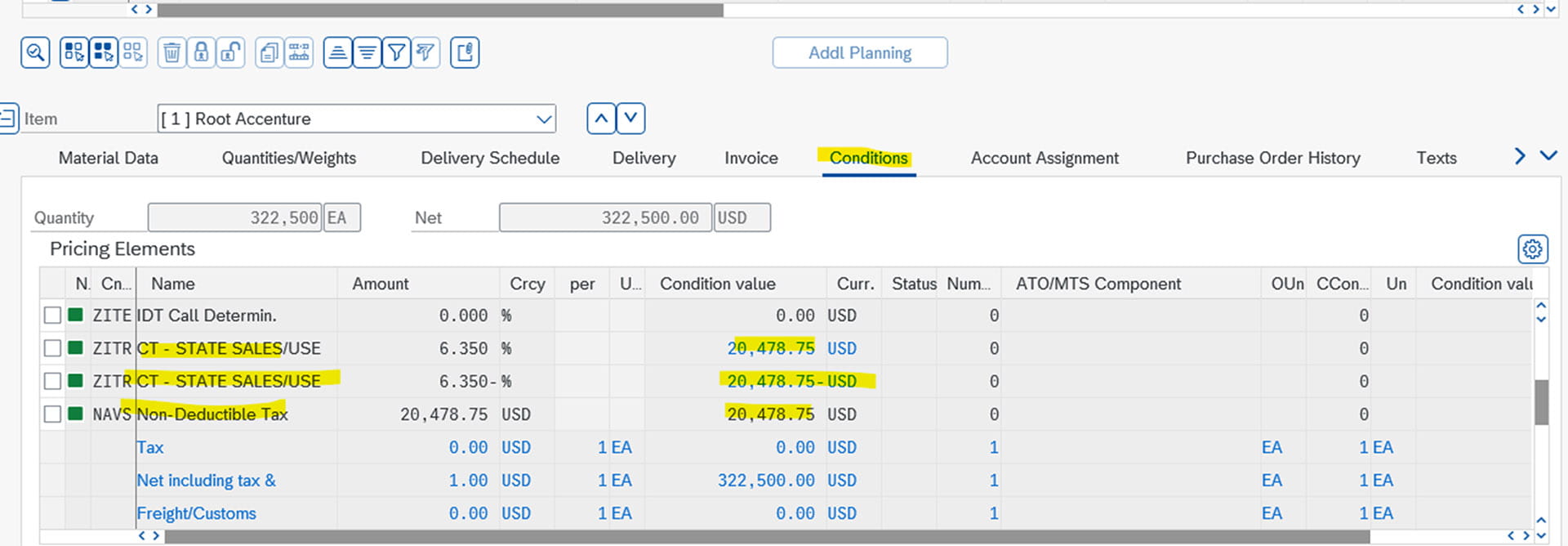
The first thing you need to check is that the three critical input fields as described in the “How is the taxability of a purchase determined?” section above is accurate. These areas are as follows:
- Make sure the material group (commodity code if using Ariba) accurately describes what you are purchasing. If it is not, you should use a more accurate one.
- Check that the cost center on the PO or the cost center associated with the WBS element or internal order number matches the operations this purchase is for. For example, if you are buying equipment used in manufacturing then the cost center should be one related to mfg.
- Check that the ship to location is where the goods are being shipped
Based on the above directions, please fix the PO and reprocess to determine if the transaction is not taxable. If not, please email the Sales Tax Department with the following information:
- Legal entity/company code making the purchase (E.g. Collins Aerospace is not a legal entity, it’s a d/b/a, Rockwell Collins, Inc. is a legal entity)
- SAP PO # or Ariba requisition #, or equivalent information from non-SAP ERPs
- Describe in detail what is being purchased, how the item is being used and where the item is being shipped to/or where the service is taking place
- Please describe in detail the way it is used. For example, indicate if it’s something being incorporated into the item we are manufacturing to be sold, or whether it is M&E or tooling being used to manufacture goods or if used in R&D, quality control, material handling, MRO activities or some other operation or general facility usage
- If you are purchasing a service, please describe in detail what the service is and what operations/equipment the service is related to
- Clearly describe your issue/question
RTX typically utilizes two types of common exemption reasons:
- Resale Exemption – This is when an RTX BU purchases tangible personal property (TPP) that will be incorporated into a product we are manufacturing for resale or incorporated into a repair that we are billing a customer for. Every state allows a resale exemption for sales & use tax.
- Usage Exemption – This exemption is based on “how” the item is used in our operations and is dependent on each state’s laws. In many states RTX BUs can claim an exemption for machinery, equipment and tooling used to manufacture goods we sell and items used for R&D purposes.
Most states do not tax services, however some states will tax specific services, called enumerated services. Please send an email to the Sales Tax Department at [email protected] with the following information in the event you have questions with respect to the taxability of services in a particular state: please send an email to the RTX Sales Tax Department with the following information:
- Legal entity/company code making the purchase (E.g. Collins Aerospace is not a legal entity, it’s a d/b/a, Rockwell Collins, Inc. is a legal entity)
- SAP PO # or Ariba requisition #, or equivalent information from non-SAP ERPs
- Describe in detail what is being purchased, how the item is being used and where the item is being shipped to/or where the service is taking place
- Please describe in detail the way it is used. For example, indicate if it’s something being incorporated into the item we are manufacturing to be sold, or whether it is M&E or tooling being used to manufacture goods or if used in R&D, quality control, material handling, MRO activities or some other operation or general facility usage
- If you are purchasing a service, please describe in detail what the service is and what operations/equipment the service is related to
- Clearly describe your issue/question
Taxability is not based on whether the purchase is capitalized or expensed. It’s based on the three factors outlined below
- What is being purchased – Typically defined by material group (Commodity code if using Ariba. hRC business units use the GL account to determine what is purchased
- How the item is being used – This is typically determined by the cost object including cost center, internal order #, or WBS element. This will let the system know if the item being purchased is used in an exempt manner. Examples of exempt usage may include manufacturing, R&D, quality control, which can be exempt, whereas facilities and G&A are typically taxable.
- Where is the item being used – This is determined by the delivery address for POs and tax jurisdiction on the cost object for non-PO purchases.
Users may create a PO to send an informational call to OneSource to provide a preliminary answer on taxability. If you have any questions after this initial feedback, please send an email to the Sales Tax with the following information:
- Legal entity/company code making the purchase (E.g. Collins Aerospace is not a legal entity, it’s a d/b/a, Rockwell Collins, Inc. is a legal entity)
- SAP PO # or Ariba requisition #, or equivalent information from non-SAP ERPs
- Describe in detail what is being purchased, how the item is being used and where the item is being shipped to/or where the service is taking place
- Please describe in detail the way it is used. For example, indicate if it’s something being incorporated into the item we are manufacturing to be sold, or whether it is M&E or tooling being used to manufacture goods or if used in R&D, quality control, material handling, MRO activities or some other operation or general facility usage
- If you are purchasing a service, please describe in detail what the service is and what operations/equipment the service is related to
- Clearly describe your issue/question
This will occur if the PO was deemed taxable and sales taxes were not included in the budget related to the PO. Check that the PO included the correct tax drivers to ensure that the taxability determination is correct. If you have questions, send an email to the RTX Sales Tax Department for clarification on the taxability of the purchase with the following information:
- Legal entity/company code making the purchase (E.g. Collins Aerospace is not a legal entity, it’s a d/b/a, Rockwell Collins, Inc. is a legal entity)
- SAP PO # or Ariba requisition #, or equivalent information from non-SAP ERPs
- Describe in detail what is being purchased, how the item is being used and where the item is being shipped to/or where the service is taking place
- Please describe in detail the way it is used. For example, indicate if it’s something being incorporated into the item we are manufacturing to be sold, or whether it is M&E or tooling being used to manufacture goods or if used in R&D, quality control, material handling, MRO activities or some other operation or general facility usage
- If you are purchasing a service, please describe in detail what the service is and what operations/equipment the service is related to
- Clearly describe your issue/question
Glossary
Ariba – A cloud based non product procurement and supply chain management platform. It is used to buy goods and services, onboard and manage suppliers and process invoices and payments. It also ensures suppliers submit invoices in compliant formats and supports tax calculation and validation.
Avalara CertCapture – A third party-cloud-based certificate management software application that transmits exemption certificate information to OneSource. Calls from SAP to OneSource associated with customer invoices are evaluated as exempt if a certificate is loaded in OneSource.
CertCapture Transmittal Sheet – The cover sheet associated with the exemption certificate submitted to CertCapture that provides information needed by CertCapture to properly apply the exemption / resale certificate to the correct customer account. A copy of the cover sheet can be found in the “Collins hUTAS Cert Upload Process” located in the Appendix.
Direct Payment Permit - Allows either a Buyer or Seller to purchase taxable items without paying sales tax to its Suppliers. A direct pay permit holder is responsible for calculating and remitting the appropriate tax directly to the state.
Exemption Certificate - A document either a Buyer or Seller provides to claim that a purchase or sale is exempt from sales tax & use tax under specific legal grounds—such as resale, manufacturing, or nonprofit status. The issuer of the certificate does not pay tax because the law exempts the transaction by statute or regulation.
OneSource – A Thomson Reuters real-time software application that evaluates SAP purchase and sales transactions for taxability. Both sales and use tax is passed to SAP as a liability for payment to the appropriate states and local jurisdictions.
OneSource is used by RTX Corp., Collins UTAS and Goodrich BUs, PW and PWC.
Vertex - A real-time software application that evaluates SAP purchase and sales transactions for taxability. Both sales and use tax is passed to SAP as a liability for payment to the appropriate states and local jurisdictions. Vertex is used by the Rockwell Collins BUs and Raytheon Company.