
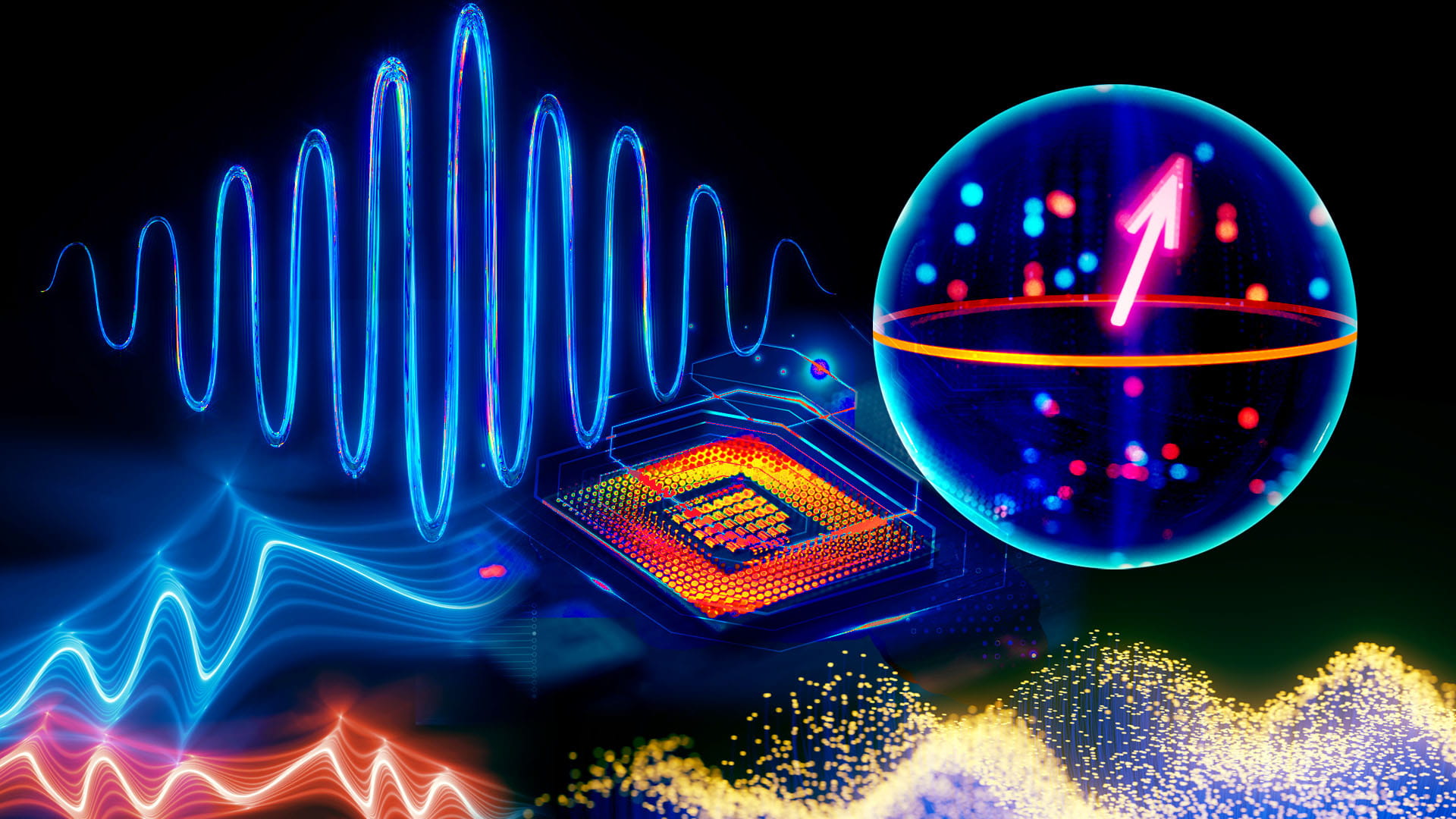
Program goal
Enhance environmental awareness by developing a next-generation, compact, low-power, deployable photonic sensor that offers more than 10 times the precision of current sensors.
BBN operates at the intersection of physics, engineering and computer science, pushing the boundaries of quantum technologies, next-gen computing and photonics. By pioneering novel quantum and classical computing architectures and applying unique characterization techniques, BBN is working to enable future coprocessors that can solve complex real-world problems. To support the growing quantum ecosystem, BBN offers commercial components that address critical supply chain needs. The team is also developing integrated photonic systems for optical computing, advanced imaging, compact quantum sensing platforms, and biophotonics applications. Through these efforts, BBN is disrupting traditional computing and sensing paradigms to deliver scalable, high-performance solutions powered by advancements in novel computing, photonics, quantum computing and quantum sensing.
To make real-time, cost-effective computation more accessible in critical settings, BBN explores novel computing techniques that deliver significant energy savings and reduce training and inference costs. By accelerating complex computations and lowering energy demands, these superconducting, optical and hybrid photonic-electronic platforms naturally perform key mathematical operations such as convolutions and matrix-vector multiplication, allowing for faster, more efficient processing. BBN’s platforms address the growing challenge of scaling AI and other resource-intensive tasks by lowering operational barriers.
BBN advances next-generation photonic technology to overcome the size, weight, power and performance limitations of traditional bulk optics and electronics. Through theoretical and applied physics-based approaches, BBN's research focuses on integrated photonics, hybrid photonic-electronic platforms and optical microsystems across both classical and quantum domains. Key technologies include photonic integrated circuits, nonlinear photonics, quantum sensors and modern electromagnetic devices. These advancements are transforming photonics-based information sensing, processing and transmission, with applications spanning image sensing, signal processing, laser communications, novel computing, secure networking and more.
Distribution Statement “A” (Approved for Public Release, Distribution Unlimited).
To unlock the transformative potential of quantum computing, BBN addresses the key challenges that limit the scalability and performance of current quantum devices. By improving qubit performance, optimizing control mechanisms and reducing noise and loss in superconducting circuits, BBN is advancing the future adoption of quantum systems for practical, real-world applications. The team also explores innovative algorithms such as quantum reservoir computing to enable real-time data processing.
The project or effort depicted was or is supported by the U.S. Army Research Office (ARO). The content of the information does not necessarily reflect the position or the policy of the U.S. government, and no official endorsement should be inferred.
BBN delivers highly sensitive, compact quantum sensing solutions that enable mission success in GPS-denied and contested environments. These next-generation technologies achieve measurements with quantum-limited precision and accuracy across a wide range of applications, including electromagnetic field sensing, navigation, imaging and RF communications. BBN advances sensing capabilities beyond classical limits by leveraging solid-state platforms such as integrated photonics, nitrogen-vacancy color centers and nonclassical light generation. Through the integration of novel materials, photonics and electronics, BBN develops robust sensors optimized for small form-factor platforms and complex operational demands.
To support the next generation of quantum technologies, BBN develops high-performance components essential for large-scale, utility-ready quantum systems. Backed by a world-class team of experts, BBN transforms cutting-edge research into real-world solutions, including superconducting parametric amplifiers and filters engineered to meet the demands of quantum applications.
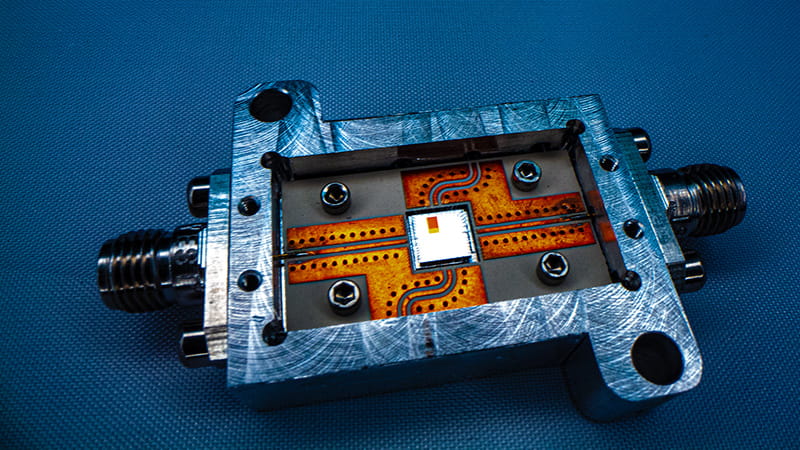
BBN’s parametric amplifiers improve signal quality by minimizing unwanted noise, allowing for precise qubit control and optimized performance of quantum systems. Designed for superconducting qubits, these broadband amplifiers provide high-fidelity readouts across multiple frequencies and approach the fundamental limits on added noise, strengthening the performance and robustness of quantum applications.

PACE4ACE automatically reroutes network traffic in contested environments to ensure uninterrupted communications

DARPA-funded Maude-HCS rapidly validates hidden communications

RTX BBN Technologies to develop long-range X-ray imaging algorithms to enable the identification of hard-to-access objects
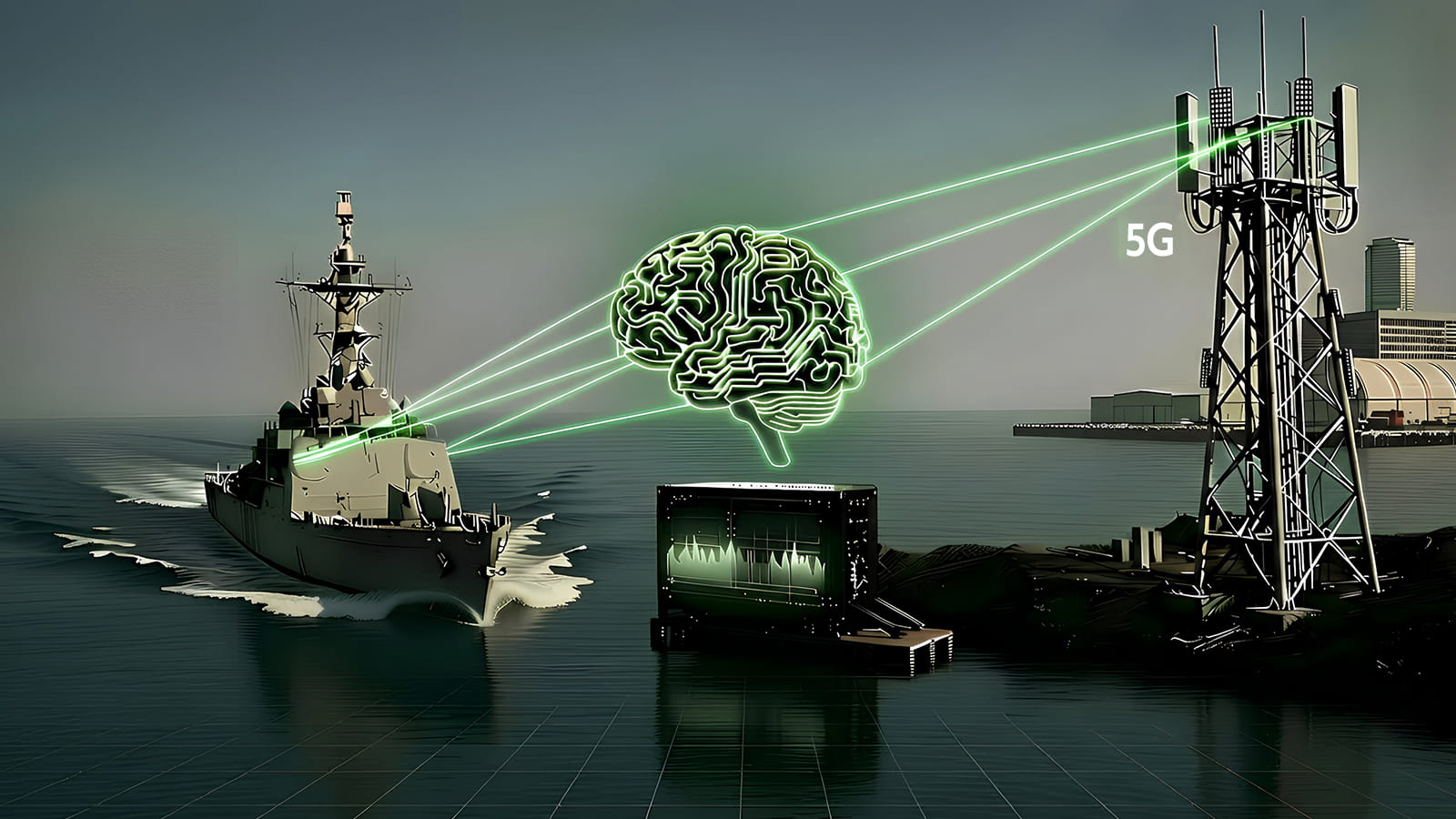
Team to build prototype that protects defense radars when the 3.1 to 3.45 GHz band is opened for commercial use