
Innovating at the speed of need
How the world’s largest aerospace and defense company turns scale into speed
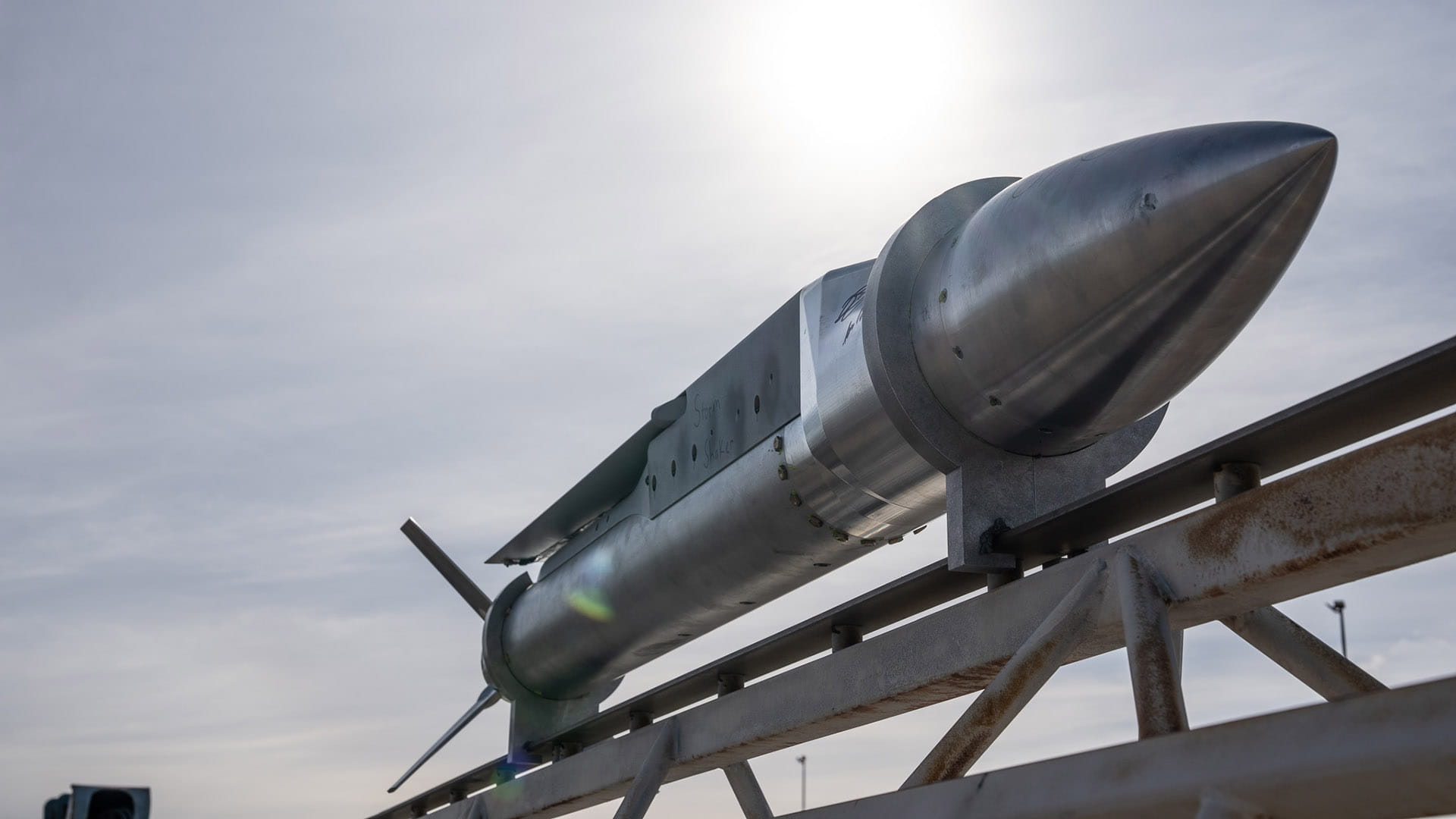
On a portable launch platform at a private testing range in the Mojave Desert, a silver rocket awaited its moment.
Nearby, engineers from Raytheon, an RTX business, watched as it shot 20,000 feet into the sky, leaving a plume of golden sand in its wake.
The 2025 test was the first for a new ground-launched variant of Raytheon’s StormBreaker® smart weapon. The munition, designed to work in all weather conditions, performed as expected. But what made the test remarkable was that just two months earlier, it had been merely an idea.
The ability to move the variant from design to testing in just 50 days reflects RTX’s commitment to its customers, who are calling for advanced capabilities much faster than the years-long development cycles that once defined the industry.
For RTX, the demand for speed creates a unique challenge: to work with the nimbleness of a startup while taking advantage of the company’s scope, scale and legacy – three businesses, 180,000 employees and more than a century’s worth of experience.
It’s a challenge fit for a company of nearly 60,000 engineers, said Scott Kaslusky, RTX’s vice president of aerospace technology.
“Our engineers like to innovate. They like to break constraints,” he said. “If presented with a challenge that says ‘We’ve got to find a way to do this in 50 days,’ they’re ready for it.”
Quickly adapting proven platforms
Part of the reason the ground-launched StormBreaker munition variant came about so quickly was that it had a head start. The system it was based on – a gliding munition launched by aircraft – has been developed, tested and refined over years. That track record of past success made it possible to quickly design and test a version that could be launched from the ground.
“The key to being nimble is being able to build on what we already have,” said Zac Dutton, vice president of defense technology at RTX. “We have decades of experience that allow us to be ready for anything, and we are always looking for ways to refine our processes to respond to our customers’ needs.”
“Our engineers like to innovate. They like to break constraints. If presented with a challenge that says, ‘We’ve got to find a way to do this in 50 days,’ they’re ready for it.”
Scott Kaslusky | Vice president of aerospace technology | RTX
Optimizing designs for quality, safety and speed
At GATORWORKS – an advanced development arm for military propulsion at Pratt & Whitney, an RTX business – engineers are speeding production through redesign and modification. Take, for example, the TJ150 compact turbojet engine. Through additive manufacturing, Pratt & Whitney engineers decreased the number of parts in a core module from more than 50 to just a handful. The reimagined engine went from concept to test in just eight months, and the simplified design will speed production as well.
“Speed, quality and safety don’t have to be in conflict with one another,” said Kaslusky. “From a production standpoint, speed and quality come from flow. The same is true in design. The more efficiently you can run and rerun tests, the more you can get out of them.”
The GATORWORKS team is bringing similar innovations to the creation of a new family of engines being produced for effectors and collaborative combat aircraft. Scalable architecture, additive manufacturing and commonality across models are all helping to keep production timelines tight – without sacrificing quality.
The speed of digital design
RTX has defined its mission as connecting and protecting the world, and chief data and AI officer Dayan Anandappa believes this mission gives the company a responsibility to operate as efficiently as possible. A crucial part of this efficiency is RTX’s embrace of digital engineering, which has digitized design processes that were once entirely analog.
“This has sped up everything from concept to design to engineering to manufacturing,” Anandappa said. “We can refine a design much more quickly, get customer feedback earlier, and move forward with the speed you’d expect from a high-flying software company.”
Digital engineering allows teams around the world to collaborate in real time, implementing necessary changes within minutes instead of months. By connecting teams across different departments, digital engineering has led not only to increased speed but also improved quality.
A next-gen engine designed using next-gen models

The U.S. Air Force has called for a new style of fighter jet engine – one that can adapt in mid-flight to deliver high thrust or high efficiency, depending on the needs of the moment. A new style of engine called for a new approach to design, replacing two-dimensional paper designs with 3D digital twin modeling. Last year, Pratt & Whitney invested more than $30 million – in addition to investment by RTX and work completed under government contracts – to further develop its model-based environment, which significantly improves the accuracy of propulsion design.
“This kind of streamlined process is one of the key things that have allowed us to go really fast,” said Kaslusky. “We’ve simplified our digital environments, consolidated our networks and created these kinds of prototyping tools that make it easier for our engineers to work together.”
The business’ proposal for that engine, known as the XA103, marks the first time a propulsion solution has been fully designed in a digital environment. By setting stringent digital requirements for their supply base and internal teams and distributing advanced digital design models, Pratt & Whitney is shortening development times, reducing costs and increasing design efficiency.
An in-house tool that finds unprecedented solutions
RTX also uses proprietary software to kickstart new designs. When a team was working on a new style of engine that takes advantage of hydrogen’s properties as a fuel, for example, they had about 70 parts to work with and billions of possible combinations. That software, known as DISCOVER, flagged a tiny fraction of those possibilities – about 4,000 – as worth exploring.
The tool has become valuable for engineers across RTX. A Collins Aerospace team used it to design a new power and thermal management system for the U.S. Air Force. Raytheon engineers have used it to find new ways to build microelectronics. A Pratt & Whitney team asked it to find viable designs for hybrid-electric propulsion systems – a project they were working in partnership with national research universities. Such collaboration, Kaslusky said, also allows RTX to move quickly.
“We have some 45 research agreements with major universities,” he said. “Those are established relationships that we use to stay close to cutting-edge research. Similarly, we have partnerships with startup companies that we tap as a source for new ideas. Those networks keep us at the edge of what’s possible in our industry.”