High-Tech Overhaul Shop: Robots Peen, Plate & Plasma Spray
By Pratt & Whitney Customer Service
Engine 4.0 overhaul takes place in the P&WC Engine Services next-generation aircraft repair shop. Sophisticated robots and systems ensure unmatched precision, quality, and speed.
"Repair workshop." These words are often accompanied by the image of workers in oil-stained overalls handling tools in a room that leaves something to be desired.
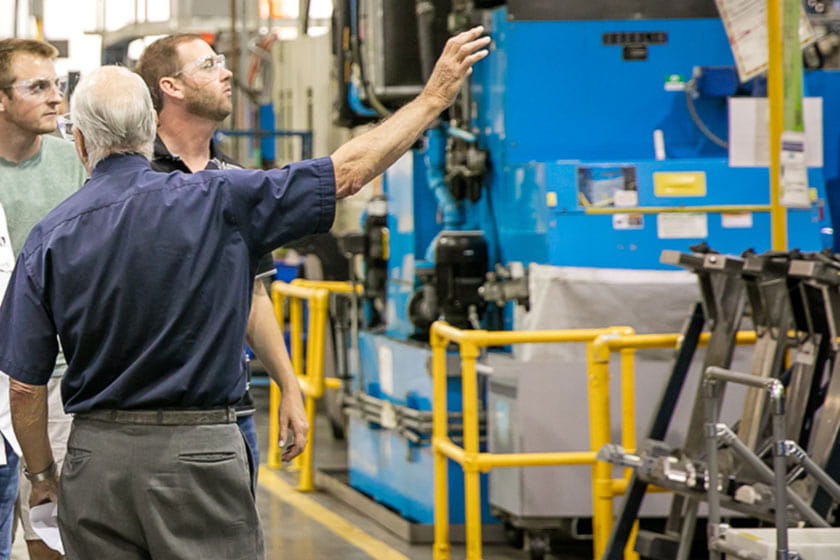
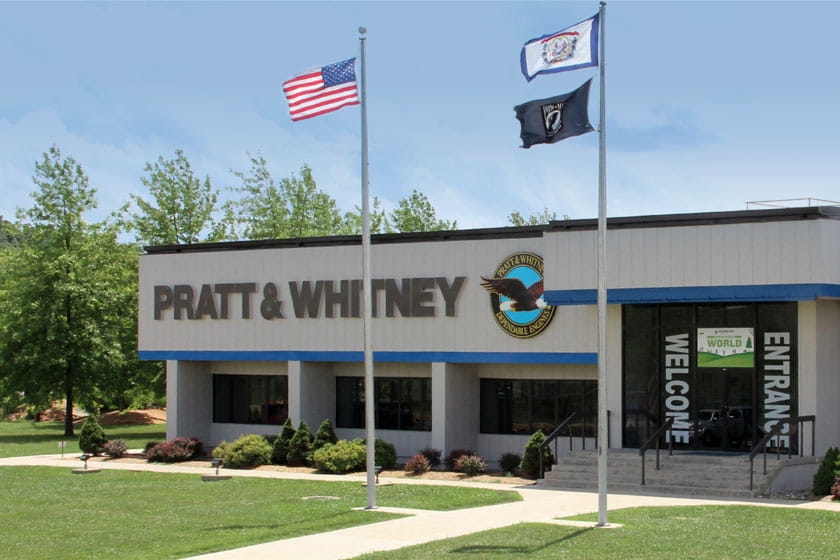
But the P&WC Engine Services shop in Bridgeport, West Virginia, offers a completely different picture.
Used for the repair and overhaul of PT6A, JT15D, PW300 and PW500 family engines, the workshop has adopted the latest in innovation, leveraging a formidable arsenal of technologies, including an automated shot blasting system, a full-capacity electroplating line, as well as plasma spraying and X-ray equipment. These new features reduce turnaround times and improve the accuracy of repairs and overhauls.
AUTOMATED SHOT BLASTING
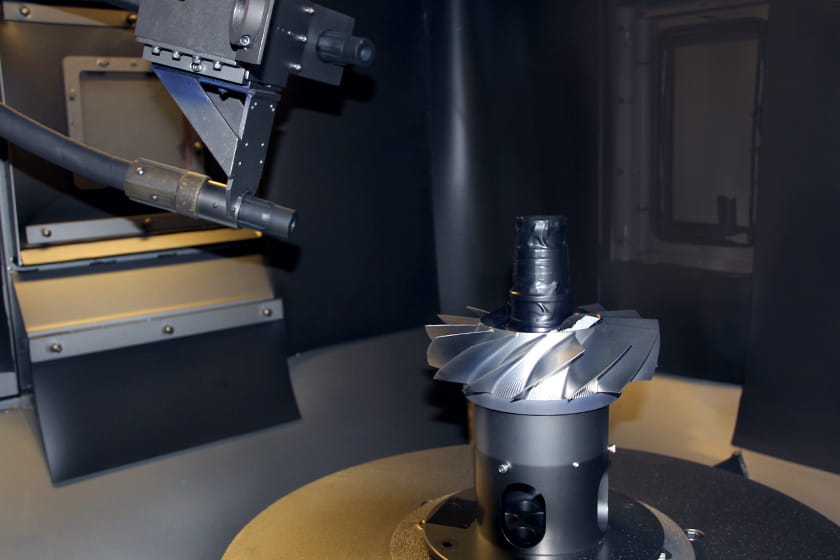
Shot blasting is a technique that consists of projecting glass or steel onto the surface of a part to apply a compressive stress. This stress benefits engine parts because it makes them more resistant during operation to the stress in tension, which creates expansion. The use of computer numerical control (CNC) robots for shot blasting ensures accuracy, as robots perform their tasks with much greater repeatability than humans.
"Stress can affect the life of a part," notes Mark Dettori, Senior Engineer, Repair Processes. We therefore apply compressive stress through shot blasting to counteract this phenomenon and improve fatigue strength. This technique also improves adhesion when a coating is applied afterwards. »
It is estimated that a thousand parts were previously sent for shot blasting each year, which required a lot of time and generated increasing costs. "The more critical rotating components are handled, the more likely they are to be damaged," says Jeffrey Powell, Manager, Business Development. P&WC Engine Services now handles it in-house, reducing the risk of accidental damage, as well as shipping and outsourcing costs.
"In my opinion, we've cut costs in half by reducing the hourly rate and saving on shipping parts to the outside supplier," says Dettori. We also created a methodology with one of our partners, reducing the cost of the dies that hold the parts during blasting. »
"Technology is a way to maintain a competitive edge and help operators with quick and cost-effective repairs." – Jeffrey Powell, Manager, Business Development, P&WC Engine Services
"You always have to look 5 to 10 years ahead," Tom Rhine, Manager, Logistics and Component Repair, told Airtime. We actually started shot blasting 5 or 6 years ago, because we saw it as a demand and an opportunity to better serve customers. »
ELECTROPLATING ADAPTED TO AVIATION
P&WC Engine Services has a competitive advantage thanks to the complete plating line, which can occasionally be used to apply nickel or chromium to worn parts to their original dimensions or to apply a protective coating (cadmium, silver, etc.).
"Only a few repair and overhaul shops have full electroplating capabilities, including ours. We have world-class facilities that are suitable for any type of P&WC engine," notes Jeffrey Powell.
"We do all the electroplating on site," adds David Slakes, Project Engineer, Aftermarket Repair. This is a rare thing for a repair and overhaul shop. In general, electroplating shops do not specialize in aviation. Also, if you send them coins, you'll have to stick to their schedule because they're few and very popular. »
"Electroplating is a very specialized field and subject to strict rules. It takes a lot of investment to make it work, in addition to having a sophisticated wastewater treatment system. We have been investing in it for decades. The water we treat is of better quality than the water we use for the process. – Tom Rhine, Manager, Logistics and Component Repair, P&WC Engine Services
HIGH-PRECISION PLASMA SPRAYING AND MORE
Plasma spraying uses robotics to improve accuracy and repeatability. Similar to electroplating, it can be used to coat worn engine parts with temperatures of up to 5000°C that melt the coating before it is sprayed onto components with a large compressor, cooler and high-voltage console. The powders are injected axially into the plasma stream and accelerated until they reach an extremely high velocity.
Our facilities also rely on X-rays to verify the quality of welds and on a CMM (coordinate measurement) inspection machine that is used to check the dimensions.
EACH COMPONENT IS UNIQUE
An engine is like a snowflake: no two are the same. This is what Jeffrey Powell explained to Airtime: "Each engine we receive in the workshop is different in its nature, its duration of use, its operating environment, etc. In fact, in 30 years of service, I doubt that we have done the same repair on an engine twice. »
"Thanks to new technologies, we have greatly reduced engine overhaul turnaround times, which is a significant advantage." – Mark Dettori, Senior Engineer, Repair Processes
Each component must be considered separately because of the high precision required by P&WC, especially for rotational compressors such as one-piece bladed rotors, impellers and blowers.
Turnaround time is a strategic parameter for P&WC. "Our customers are very keen on this because they want to reduce downtime as much as possible and make sure that downtime is predictable and planned," says Dettori.
When it comes to overhaul and repair technology, P&WC and its partners are pushing the boundaries of what's possible. Airtime also covered remote borescope inspection, oil analysis technology, and sustainable practices.