
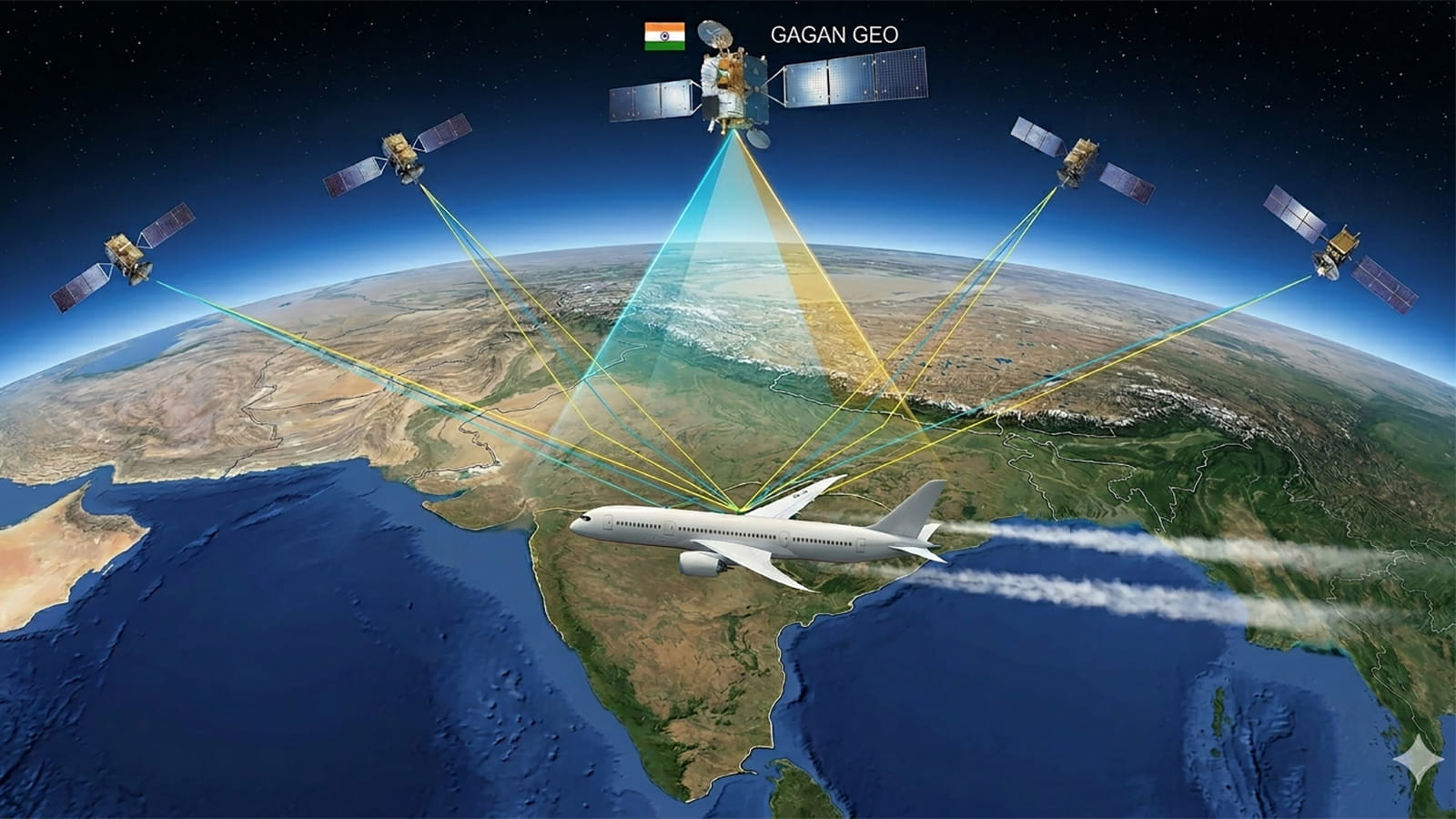
GAGAN enhances GPS signal accuracy by:
- Monitoring satellite signal performance
- Calculating positioning errors
- Transmitting augmentation data to SBAS/GAGAN receivers
The GPS Aided GEO Augmented Navigation (GAGAN) is India’s Satellite-Based Augmentation System (SBAS). It is designed to enhance GPS performance and enable precision approach and landing capabilities across the region.
GAGAN supports all phases of flight and provides an Approach with Vertical Guidance (APV-1) landing capability across the Indian landmass. It also enables Request Navigation Performance (RNP 0.1) En-route operations within India’s Fly Information Region (FIR), with the potential to expand into neighboring FIRs.
Beyond aviation, GAGAN’s GPS signal corrections benefit non-aviation SBAS-capable receivers by enabling precise positioning and navigation across various sectors, including agriculture, surveying, railways, maritime navigation, and more.
GAGAN was developed in collaboration with:
Collins Aerospace is a critical player, leveraging its Wide Area Augmentation System (WAAS) Localizer Performance with Vertical (LPV) guidance software baseline developed for U.S. aviation authorities and adapting it for GAGAN with configuration changes and the development of new ionospheric algorithms suited to the equatorial region.
Development of GAGAN began in 2004, and the system became fully operational in 2013. GAGAN was subsequently certified for APV-1 operations on April 21, 2015.
Following its operational certification, GAGAN has continued to evolve with several system enhancements.
These enhancements ensure continued performance and scalability for future aviation needs.
With the full GPS modern L5 signal constellation expected to be available around 2027, Collins and AAI are actively planning to introduce GAGAN dual-frequency service while maintaining the single-frequency service. This dual-frequency service will further enhance system accuracy, availability, continuity, and integrity for users equipped with dual-frequency receivers.
The introduction of dual-frequency service will significantly improve GAGAN performance, particularly during periods of severe ionospheric disturbances such as solar storms, thereby improving overall system availability and robustness.
GAGAN represents a significant technological milestone, addressing the unique challenges of the equatorial region, which is prone to ionospheric disturbances that can adversely affect GPS performance.
I would like more information about this capability.
Air Traffic Solutions